Autism Spectrum Disorder and Sensory Processing
Autism is part of natural neurodiversity. Many autistic individuals experience differences in how their brains process light, sound, and movement. Our neuro-optometric approach helps reduce sensory overload so patients can engage more comfortably in school, work, and daily life.
Why Do Sensory Differences Matter in Autism?
Autism Spectrum Disorder (ASD) is part of natural neurodiversity and reflects unique ways of thinking, learning, and interacting with the world. Many autistic individuals experience differences in how their brains process light, sound, and movement — sometimes focusing like a spotlight on details or overwhelmed by floodlight input. At the Mind-Eye Institute, we help rebalance these systems to reduce overload and make school, work, and daily life more comfortable.
Characteristics & Sensory Processing
Autism is a neurodevelopmental condition that includes diverse patterns of communication, social interaction, and behavior. According to the CDC, 1 in 36 children in the U.S. are autistic. Research shows that visual and auditory processing differences are common in autism, which may contribute to experiences of sensory overload in noisy or visually complex environments.
Because autism is diagnosed based on behavior, underlying sensory processing differences are often overlooked. At the Mind-Eye Institute, we explore how the brain interprets what the eyes see and the ears hear — uncovering patterns that may make environments more challenging or tiring for some autistic individuals.
Common Sensory Differences & Experiences for People with Autism:

Our Unique Approach to Autism Spectrum Disorder
Traditional autism therapies often focus on communication, behavior, or social interaction. While these can be helpful, they may not address the underlying sensory differences that shape how autistic individuals experience the world. At the Mind-Eye Institute, we look beyond 20/20 vision to study how the eyes, ears, and body systems synchronize.
As Dr. Deborah Zelinsky, OD, FNORA, FCOVD explains, the brain uses three types of eyesight — for safety, navigation, and identification. In autism, these pathways often work unevenly, leaving individuals overwhelmed by peripheral detail or hyper-focused on one feature at a time. This can make eye contact, listening, or reading far more exhausting than most people realize.
By carefully adjusting the way light enters the eyes, our Brainwear™ therapeutic lenses give patients new experiences of space, timing, and sensory balance. Some children have even said, “Mommy, you have a whole face” — seeing eyes, nose, and mouth together for the first time. Our goal is not to change who a person is, but to expand awareness, reduce overload, and help autistic individuals engage more comfortably in their environments.
Listen to Dr. Zelinsky explain in her own words on the Telepathy Tapes from 3:30 to 15:45
“ When light enters the eye differently, the brain can suddenly connect vision, sound, and space in new ways."
— Dr. Deborah Zelinsky, OD, FNORA, FCOVD
So just as Katie had conducted her research, I started reaching out to different experts on the physiology of non speakers with apraxia. I first spoke with Dr. Zelinsky, an optometrist who works closely with many patients who are autistic at the Mind Eye Institute. I'm an optometrist and the subpopulations that I work with are people whose brains are not working adequately or whose brains are working differently from other people.
We'll work with brain injuries where people have to relearn things. We'll work with autism or brains are wired differently. Different genetic disorders. People with dysautonomia. Anybody where the visual input is not coming in properly or the motor output is not going out properly. Processing is different from average.
I spoke with Dr. Zelinsky to find out what's happening with the brain ocular relationship and a person with autism, and how new studies and developments can help us better understand their perception of the world around them. I should also mention she is truly a cutting edge optometrist who for 30 years before anybody else believed it, knew that there was a direct link between vision and hearing.
She was keen to remind me that just because something hasn't been proven yet doesn't mean it can't be. So Dr. Z, can you explain how vision often plays out differently for those with autism and apraxia? There's three kinds of eyesight. We have a subconscious eyesight that's keeping you safe. That scans the environment.
So if you're walking with somebody and at a subconscious level, you're scanning the ground to make sure you don't walk into a hole or trip over something. So that whole scanning ability of your periphery is subconscious. In somebody with autism, a lot of times that subconscious isn't subconscious. It's conscious, and they're looking around.
In that far periphery. So it might be why they're not making eye contact with you or seeming like they're just looking all over the place. Yeah, exactly. And the second type of eyesight is a peripheral eyesight to set the stage to be what you're aware of. So for instance, if I'm looking at your ear. The earring would be what my central eyesight is seeing details on.
But I would see your face and your hair and the surroundings. So the second eyesight would be the surroundings, and that's called peripheral eyesight. So I scan the environment subconsciously. Something's interesting, and then I choose to put my attention on that interesting spot and the peripheral takes over and says, okay, where is it?
It's here. How do I point my eyes? Then you aim and then you focus on details called control identification, eyesight. So you have this scanning safety eyesight. You have the navigational ability, eyesight, and then identification eyesight. So in autism, typically the autistic people are not using the identification and navigation system evenly.
They're not used in tandem as a team. If you're reading, there's a paragraph and your side eyesight says, here's the paragraph. It starts here, it ends there, and then your central eyesight reads the word by word or phrase by phrase. But you see it coming, it's, I'm getting to the end of the line.
I'm going back to the beginning of the line. And in autism, they're using either the peripheral, where is it pathway or the central, what is it? Pathway. And the safety pathway is at a more conscious level. Hmm. The processing of all three pathways is not the same as in a neurotypical person. They don't typically use the centralized site as a choice, and the centralized site is a slower pathway.
They don't need to use the central because they get enough information from the peripheral. Okay. That's so interesting. So they're choosing to favor the peripheral. Rather than the central, since it takes more motor control to use them in tandem. So are they processing the visual information in a different way in the brain?
So as far as what's going on in the brain, I tend to simplify it into the three different brains, the reflex, the emotional, and the thinking. I'm working on perception. And perception for communication would require four different inputs. You would have facial expressions. And body language. Those are taken in by your eyes.
And the body language is taken in by that peripheral system. And the face, the farther one, and the facial expression is by a smaller periphery. So that's why we were talking about different types of eyesight. We have body language to see the whole body. You have facial expressions because you zoom in a little bit, and then you also have tone of voice and then content of words.
So your auditory system also has kind of a background and the target, those four things, you have a right eye and a left eye, and a right ear and a left ear. So there's eight different sensory channels that all have to be synchronized for you to, to communicate easily and to understand what the other person is saying.
Doing. So what I find with the non-speaking population is that most of them are E either switching back and forth from just listening to what the person's saying to just looking at their facial features, to just paying attention to, you know, how they're moving around, but they don't see it as a whole.
Nor do they tend to watch the person's mouth while they're listening. Yeah. So many, many of the non-speaking population look down and look away from their, the people talking to them. 'cause if they look and they try to look and listen at the same time, it's too confusing. Their brains are overloaded and then they can't comprehend what's being said to them.
What do you think is different in the brain that's making it that way? Well, the way I've learned it, it's, it's a developmental thing that it, that it's the space around you. When I see autistic people, they have a particular spot in space that they're comfortable with, but they're not comfortable with the entire chunk of space around them.
So I've, I've made up a continuum and we call one, one example. One end of it would be like a floodlight mode. So if you went to a theater and there's a floodlight on, you don't know where to put your attention. Stuff's happening everywhere. When the theater wants you to pay attention to one person, they turn the lights down, they turn the lights dimmer, and there's one spotlight on one person, and then you know where to put your attention.
So it's a continuum from Penlight or spotlight mode. All the way to floodlight mode. Mm. And the neat thing about the brain is it can turn the peripheral eyesight off and on and shrink it and expand it. And in the autistic population that shrinkage and expansion of the space around them, that's not working properly, they don't have the ability to do it.
It's a skill that's not been learned. People who have autism are usually stuck in the penlight mode and not paying attention to the floodlight mode. Which could have its strengths really. The autistic population has a lot of strengths and that's the whole thing. It's like it's a subpopulation.
So like when we see them at Mind Eye Institute, I'm not trying to change anybody. Mm-hmm. We're trying to explain to them how they can better like. Communicate with the people who aren't perceiving the way they are. So you have to, in order to communicate, you need to understand where the other person is coming from.
And like if you have a parent and a child, even a neurotypical child, the child cannot see the parent's viewpoint 'cause they haven't gone through what the parent's gone through. Yeah. Parents have to come down to the child's viewpoint. So it's a non-speaking autistic person. Versus a parent or another person, the autistic child is stuck trying to figure out what the other person is wanting and they can't put themselves in that shoe.
So if we could give them experiences by putting glasses on to change the way the environment looks. So that the taste of, oh, when my eyes and ears are connected, this is how the world is, or when I'm coming from another perspective, this is how they might see me. Then they'd be more aware of how their behaviors are affecting other people.
The glasses are designed for the peripheral section of the eye as opposed to standard glasses that are designed to identify a target. We've had some of those children who all of a sudden start to be more aware. One was a verbal child, but it was funny. After they got glasses, they said to their mother, oh mommy, you have a whole face.
I can see your eyes and your nose and your mouth at the same time. Oh, they had been like four years of their life. Just seeing a nose or just a mouth or just an ear and moving around a lot to see everything. It's changing a brain process. It's giving them information of if everything came in, in an angle or from above or from below.
Or it's, uh, magnified on one side but not the other. So it's slanted. It changes the person's posture, which changes the chunk of space that they're aware of. So for the autistic population, a lot of times we have to change the wave. Their center of gravity is to make them lean back or lean forward. The identification.
Seeing a letter on a chart, that's one thing, but that's just one piece of your eyesight. Mm-hmm. That's not the important piece. 'cause that's the slowest piece. And the eye exam designed to identify letters on a chart was designed before the light bulb was invented back in the 1800s. So we're still using that 160 years later when it's, it's not sufficient for the autistic population or the dysautonomia population.
Or any sort of brain injury. There just has to be a change in the way eye exams are being done. 'cause it, it's only been in the last maybe 15, 20 years that it was known that their eye, ear linkages, they could just prove it's, there's all these new discoveries and yet nobody's changing the eye exam. Okay.
I guess the last thing I wanna ask you is, what advice would you give to a parent or family member who has an autistic child or young adult and they're having issues visually? Well, I first tell them that there's habits that have to be broken and then a process of building new habits so that I tell them to be patient and take the time and understand that their child is not broken.
Their child is just different. You have to break the old one. Show them a new one and have them rehearse the new one, and then they will want to go back to their old habit 'cause it's comfortable. Mm-hmm. So you have to also be cognizant of, well, what's in their comfort zone versus what's tolerant for them.
So, you know, like they might never like to go out to, you know, drag races where there's cars making a lot of noise. Because the sound, they might have sound sensitivity, so you can't change who they are as a person, but you can expand what they're aware of that somebody who's in penlight mode, most of the time when you expand to turn on the floodlight and you blur the central part and they go, wow.
Mm-hmm. It gives them that experience. But sometimes it's scary because you have, like I said earlier, an emotional brain that's guiding the thinking brain. A reflex brain is guiding the emotional brain, so when you put different glasses on, you can change the body chemistry and the chemistry changes the brain activity.
I would love for my legacy to be, to change the way the eye exams are. We're in the 21st century and we're doing eye exams the way they were designed in the 1800s or 19th century. And for the autistic population and the non-speaking people, it's critical. I mean, it's absolutely critical.

What We Look For
Our 3–4 hour neuro-optometric evaluation explores how the brain processes sensory input in real-world conditions, including:
How We Help
When sensory systems are out of sync, the brain works harder to stay regulated. This can show up as fatigue, withdrawal, or stress in daily routines. Our tools are designed to reduce overload and support regulation:
Why It Matters
By addressing sensory processing differences, many patients experience:
Success Story: Eyeglasses that Listen
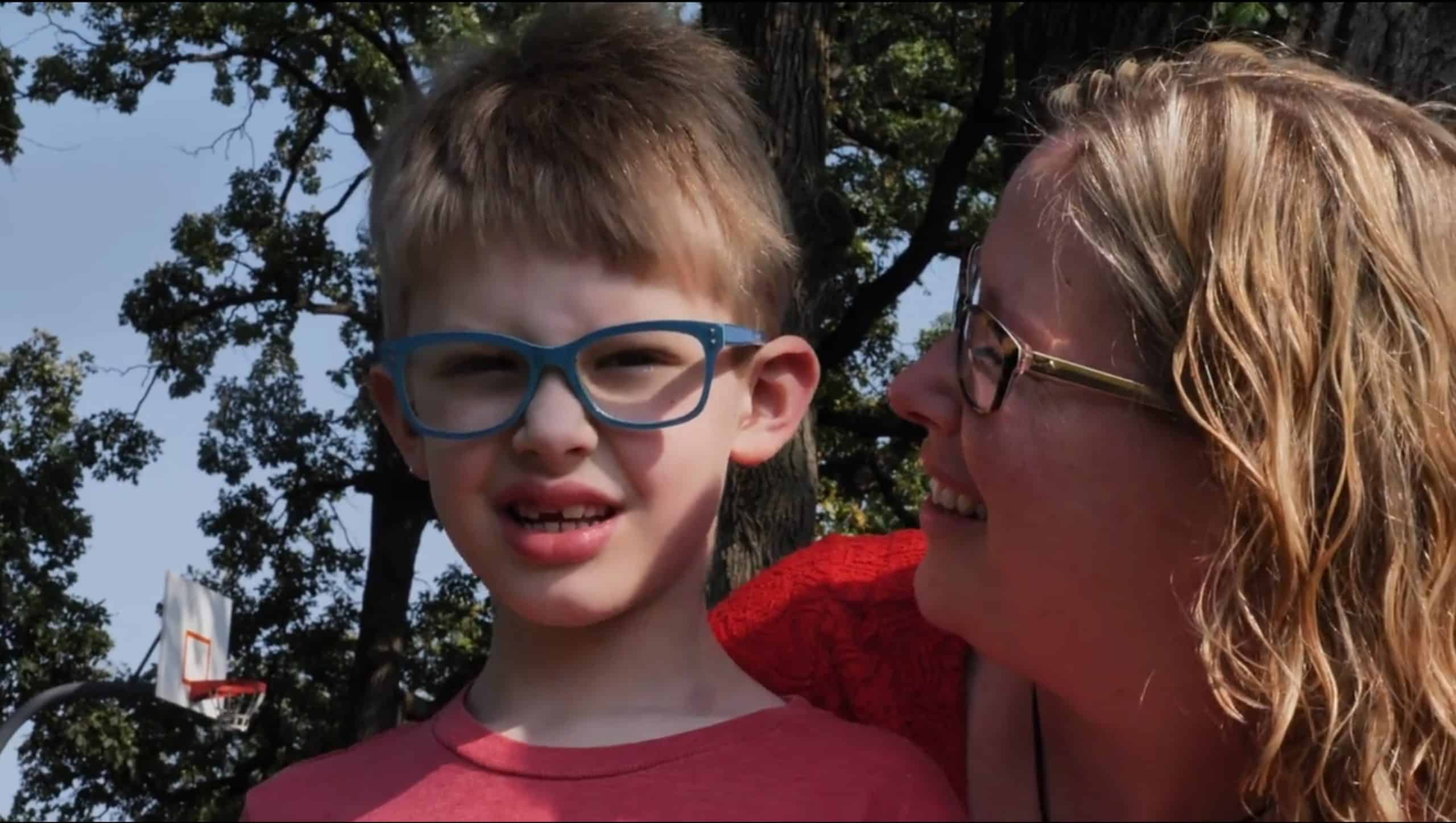
Eli’s story shows how powerful this can be. As his mother explains, they had tried many doctors and therapies without lasting results. But within just 10 days of wearing his first pair of Brainwear™ glasses, Eli began calming himself more easily, looking people in the eye, and having real conversations. He even proudly tells everyone about his turquoise frames, saying: “I love them because they help me hear better.” His family finally saw a calmer, more confident side of him — one that had been waiting to emerge all along.
“For the first time, my son could look people in the eye and have real conversations.” — Becky, Eli's Mother
My son is diagnosed on the autism spectrum, and so he struggled a lot in school. He was just overwhelmed all the time. Noises would overwhelm him; if he got upset, he would just have huge temper tantrums and not be able to calm himself down.
He had trouble holding a conversation. When other kids would come over to play, he’d play off in the corner by himself. As a parent of a kid on the autism spectrum, I just felt like I had to research everything on my own.
We found something called movement therapy, and that’s what led us to Mind-Eye. We had our first appointment at Mind-Eye around last November.
When he first got his glasses, within the first week he has never had a huge meltdown tantrum ever again. Isn’t that amazing? Just absolutely, absolutely amazing.
He went to school, and within one week he was able to participate in gym class and PE class—which he could never have done before. And from then on out, he was able to be in that class.
Want to Learn More?
Awards & Recognition




FAQs
FAQs
Yes. Even with clear eyesight, differences in how the brain processes visual input can make environments overwhelming. Supporting visual processing often reduces stress and makes it easier to engage.
Traditional exams test clarity. Our evaluation measures how eyes, ears, and brain coordinate — including central vs. peripheral vision, eye–ear timing (Z-Bell Test℠), and overall sensory integration.
No. Our care complements other supports by addressing sensory differences that make communication, focus, and participation more difficult.
Some families report early shifts in calmness, attention, or regulation within weeks of wearing Brainwear™ lenses. For others, improvements build gradually as the brain adapts.
Children and adults with autism — particularly those with sensory sensitivities, attention challenges, or difficulties in busy environments — often find support through neuro-optometric care.
For more general questions about our treatments, visit our Full FAQ Page.
Success Stories