

Why Are TBI Symptoms Ruining My Life?
When debilitating TBI symptoms disrupt everyday life, the cause often involves visual processing disruptions — not just eyesight. After a concussion or brain injury, the brain may struggle to synchronize signals from the eyes, ears, and body. Neuro-optometric evaluation can identify these retinal processing issues and provide customized therapeutic lenses designed to reduce visual stress, relieve sensory overload, and support overall recovery.
“My Life as I Once Knew It Is Over”
When you feel like TBI symptoms are ruining your life, it can seem as if every part of your daily routine has been stolen. Physical therapist Kristie Burns knows that feeling firsthand. Following a head injury in a high-speed motor vehicle crash in January 2022, Kristie found herself struggling with constant low-grade headaches, sensory overstimulation, and visual processing challenges that left her fatigued, nauseous, dizzy, and ill.
Reading became a battle. “My eyes would jump back and forth across the printed lines,” she
recalls.
Driving was disorienting. “When in a car, the road seemed to move faster than I was. If I looked to the left, it seemed as if I were still looking to the right, and vice versa,” she relates.
Only in her early 40s, Kristie began contemplating the unthinkable — walking away from the career she loved. “I started planning retirement [as a physical therapist] and considered looking for work that would not require the kind of high-level problem-solving, thinking, and patient care I had been doing. I was very scared. I was thinking no way can my life continue in this way. I am too young.”
Important context: Mind-Eye Institute clinicians are Doctors of Optometry. They do not provide a remedy for the brain injury itself. Their focus is on alleviating the visual stress and retinal processing disruptions that often follow concussion and TBI.Key Takeaways
- TBI symptoms ruining your life — like constant headaches, reading difficulties, and sensory overload — may stem from disrupted visual processing, not damaged eyesight.
- Neuro-optometric care does not provide a remedy for the brain injury itself; it focuses on alleviating the visual stress and retinal processing disruptions that can follow concussion or TBI.
- Customized therapeutic lenses (Brainwear™) can redirect how light enters the retina, helping the brain better blend signals from the eyes, ears, and body.
- Physical therapist Kristie Burns experienced progressive symptom relief — including reduced headaches, improved reading, and a return to exercise — after her neuro-optometric evaluation at the Mind-Eye Institute.
- A neuro-optometric evaluation is specifically designed to examine peripheral eyesight usage and multi-sensory integration — dimensions of visual processing that are central to post-TBI difficulties.
I was driving home from work and I was t boned. It was a pretty high speed motor vehicle accident. My car rolled up on the driver's side two wheels, spun 270 degrees and thankfully righted itself. I did not flip, but my head did smash up against the driver's side of the car at least once, maybe twice, that I remember.
Initially, I felt beat up. My back, my neck had a headache. My foot, my everything just hurt. It was bad. The car was totaled. I work in healthcare and I thought this is gonna be sore. I'm gonna be real beat up. I was ready for that. I did not go to the hospital. Everything seemed to be just like your typical MVA.
But midnight that night I woke up with what I swore was someone stabbing me in the top of my head. I thought I had a knife sticking out of my skull. It was blinding. It was excruciating. I saw my doctor a couple days later. Everything came back normal for imaging wise anyway. And they said, just relax.
Just take it easy. this'll, you're beat up. You're very beat up. Everything should be okay. Days that followed, typical glassy eyes. Slurred speech, I was barely walking, everything just hurt so bad. I walked around in a daze. I always had a headache. My eyes were always very sensitive to light motion.
Heart rate changes. If I got moving too much, I couldn't really exercise. Couldn't do a whole lot. Because if my heart rate or I started to sweat, I would get symptoms. I'd get nauseous, dizzy, I'd start stumbling. I couldn't really do a whole lot. What I lost a lot was word processing and word finding.
I would not be able to have a conversation as fluidly with you now two years ago. This would not happen. Every sixth or seventh word I'd be stuttering. As far as reading goes, it did take extra time. My eyes at the time were jumping back and forth and I'd go down two lines and then back up three lines and so finding the words was difficult.
But it was not painful. If anything, it was more fatiguing. It probably took me longer to get through that book than it normally would have. And with some time, I continued to get better. the body aches went away. The back and neck felt better. But there was just always something missing with my head, with my brain.
I didn't see things right. I didn't perceive things correctly. It was like I was always getting motion sickness. I was always dizzy. I was always you know, if I was driving in a car, the world was moving faster than the car was. If I looked to the left, my eyes were still looking to the right. Nothing perceptually was making much sense.
I couldn't handle loud noises. I couldn't handle being around fireworks for 4th of July. Couldn't handle being in a crowded place missed a couple of family events because of, not being able to be in loud places. And so that's where I was when I, as these things evolved, I couldn't do those things.
My day is very busy. My day is very filled with, lots of multitasking, lots of patients all at the same time, managerial responsibilities, report responsibilities to my superiors. And just maintaining a professional aura of, I've got it together and everybody else has it together, and this is, everything's going to be okay.
So the challenges I had and the symptoms that I had immediately afterward made it very difficult for me to do my job. started to look for someone else to provide care when it seemed like I had exhausted everything else. The breaking point was shortly after I had been told that it was as good as it was going to get.
And so I started my own research. I'm in healthcare, so start reading things, start finding things. Maybe there's something else out there that you just haven't done. At the time, concussions were not my forte. I had no extra training. Now I do. But I just started reading things. I was probably five or eight books in when I found the book, Ghost Inside My Brain.
That book hit me pretty good and toward the end of the book when he started talking about Dr. Zelinsky and Mind-Eye, I thought, this is it. If it's not this, then it's not ever going to get better. I was at the end. I was, I'm at the time 40 years old and This is as good as it's going to get. I'm never going to be able to go to fireworks again.
I'm never going to be able to do these things. I'm not going to be able to be in busy places. Am I going to have to give up my job? I was just at the end. I was very scared. I thought there's no way my life can be like this now. I'm too young for this. And so after reading that book, I went on, found Mind-Eye and then started with Mind-Eye and with Dr.
Zelinsky at that point. When I first met Dr. Zelinsky, she came in, she was very nice, very professional. Everything was very quiet and dim lidded, which was super helpful because at the time I was very sore. When she started with the colored lenses and the bells, I thought, what is this? is this? And then she adjusted things and changed a prescription or changed a color or did something.
She took some time to explain it to me briefly with the different color lenses, meaning different parts of your eye and your retina and your brain and how the light bends in. And so it was, I couldn't understand it at a very basic level. But it was interesting. I was intrigued and it helps.
So driving up there, I was still uncomfortable. It was the way it always was. Driving home with the first pair of lenses, I felt different. I felt at ease. That was, at that point, I thought, this is huge. That was my first glimmer of hope that despite everything I've done, this was always a barrier. And this seems a smidge better.
And I wasn't even expecting it. I did not expect symptom relief or improvement in a day, in one appointment. In the weeks and probably months following, I noticed an ability to find words a little better, which was huge in my job. I have to sound like I know what I'm talking about. And I could. I finally, for the first time in a long time, wasn't struggling with finding words.
Didn't have that low grade headache that I had. For over a year, the eyes were just relaxing. I was able to just work and not have that underlying annoying pain that irritates you all day long. And that was what it was. It was just this low grade discomfort that was easing, that was subsiding, that I finally felt better and could do what I needed to do.
The important thing is now I notice. Improvements. Tangible improvements. Not just, oh, today was a good day, and yesterday was a bad day. While I still have those, it's not like that. I have more good days than bad days, and my bad days aren't nearly as bad as they used to be. With the accident, exercise was impossible.
Anytime I tried to raise my heart rate, I'd get dizzy, I'd get nauseous, my head would be screaming, and I'd be confused. I couldn't do those things. I do have a balance apparatus. And couldn't do that. Now things are better. I am nowhere near where I was in 2020/21 before the accident, but I'm getting there.
Things are getting better, and at least now I can do some of those exercises. I can get my heart rate up, I can sweat a little bit, and it does not have near the effect it did on me in the very beginning. When I had the accident, life was over. it was I was starting to plan for an early retirement.
I was starting to plan for moving into something where I could earn an income, but not do nearly the level of high level problem solving, thinking, patient care that I was before. Essentially my life as I knew it was over. I found Dr. Zelinsky. I found Mind-Eye Institute through some stroke of luck, through reading, through lots of reading.
I found them and they changed my life. They gave me the ability to have hope that I can continue doing what I'm doing, that I can continue the work that I do, that I can continue helping my own patients because Dr. Zelinsky helped me, because Mind-Eye Institute helped me. I thought my whole life was over.
I was really contemplating bad things at that point in life. And if I hadn't found her, I don't know what I would have done.
What a Neuro-Optometric Evaluation Looks For
Many people with debilitating TBI symptoms have 20/20 eyesight — and understandably wonder why they still feel so impaired. The reason is that eyesight and vision are two different things. Eyesight refers to the eye’s physical ability to gather and focus light. Vision refers to the mind’s interpretation of that light — a far more complex process involving multiple brain regions and sensory systems working together.
After a brain injury, visual processing disruptions like visual-vestibular mismatch, spatial disorientation, and sensory overload can emerge even when the eyes themselves are healthy. These disruptions reflect breakdowns in how the brain synchronizes input from the eyes, ears, and body.
A neuro-optometric evaluation is specifically designed to examine these deeper dimensions: peripheral eyesight usage, the interplay between sensory systems, and how the retina routes signals to different brain regions. For people with concussion symptoms that won’t go away, this level of evaluation can uncover visual processing issues that may be contributing to persistent difficulties.
A “Stroke of Luck”: Discovering Mind-Eye Through The Ghost in My Brain
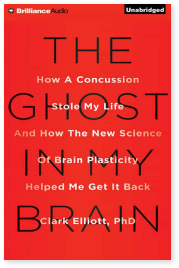
Something happened to halt Kristie’s downward trajectory. In her desperate search for help, she found the book The Ghost in My Brain, written by DePaul University Chicago professor Clark Elliott PhD. In it, Dr. Elliott describes how the advanced clinical work of Mind-Eye Institute founder and research director Deborah Zelinsky OD — a retinal processing expert — helped begin resolving his eight years of debilitating TBI symptoms in a matter of weeks.
Along with the cognition work of Donalee Markus PhD, president of Designs for Strong Minds in Highland Park, Illinois, Dr. Elliott progressed to functioning “better than normal” within two years, Dr. Zelinsky relates.
“Dr. Elliott’s book resonated with me,” says Kristie, who is a DePaul University alumna. “I went on the Mind-Eye web site, completed the questionnaire, and had a call back [from a patient advocate] in 10 minutes.”
What the Evaluation Revealed
Kristie’s first appointment at Mind-Eye came in the spring of 2023 — more than a year after the car crash. After comprehensive testing and evaluation, Dr. Zelinsky identified that Kristie was too focused on a single target and unable to process what was happening in her periphery.
“Dr. Zelinsky also indicated the background behind whatever I might be looking at overstimulated my brain; I could not process the background,” Kristie explains.
This pattern is common in people living life after traumatic brain injury. The brain, lacking sufficient energy and spatial awareness, narrows its focus as a protective mechanism — but at the cost of everyday functioning.
As part of the evaluation process, Mind-Eye clinicians may also use the patented Z-Bell℠ Test, which evaluates the synchronization between a patient’s auditory and visual spatial maps. Because the brain relies on coordinated input from both eyes and ears to build an accurate sense of space, disruptions in this synchronization can contribute to disorientation, sensory overload, and difficulty navigating busy environments.
How Retinal Processing Lenses Support Recovery
Dr. Zelinsky then customized the prescription for Kristie’s eyeglasses — therapeutic lenses referred to as Brainwear™. “She said the intent was to bend light differently as it entered my eye,” Kristie recalls.
Here is the science behind the approach: the retina is composed of brain tissue and plays a critical role in the central nervous system. Environmental signals in the form of light enter the retina and convert into electrical signals that pass through neurons and interact with key brain structures. These retinal signals influence not only the visual cortex but other significant brain regions as well.
By altering the amount, angle, and intensity of light passing through the retina — a process called retinal stimulation — Mind-Eye clinicians can help the brain more efficiently blend signals from the eyes, ears, and other senses. This may reduce visual stress, relieve sensory overload, and promote improved spatial awareness.
The result for Kristie was immediate. “I felt at ease going home. As a passenger in a car, I was able to keep my eyes open even with cars moving in different directions around me. I had not expected this kind of symptom relief in one appointment.”
Progressive Symptom Relief: Kristie’s Ongoing Improvements
In the weeks and months following her initial evaluation, Kristie noticed tangible changes.
- Verbal processing improved. She was no longer stuttering every sixth or seventh word when talking.
- The persistent headache lifted. The constant low-grade headache that had plagued her for more than a year was gone.
- Less visual fatigue at work. Her eyes felt more relaxed during long clinical days.
- Multi-tasking returned. She could again look quickly from a computer screen to a patient and then down to papers on her desk without becoming overwhelmed.
- Exercise became possible again. “After the car accident, exercise was impossible. Every time I tried to run, my heart rate would soar, and I would get nauseous. Worse, I could barely stand on my own two feet. But, today, I can exercise and push my heart rate up without experiencing all the symptoms.”

“I did not expect symptom relief after just one appointment, but I experienced exactly that.” — Kristie Burns
“Of course, today, I still have my good days and bad days, but the bad days are not as bad as they once were. I continue experiencing overall, tangible improvements in my life,” says Kristie.
More Than “Magic” — Advanced Optometric Science
Although some patients call what the Mind-Eye Institute does “magic,” Dr. Zelinsky notes, “There is no magic about it. We are using advanced optometric science to make positive changes in people’s lives.”
“Most people think of the eyes simply as an input center that sees the environment and brings visual information into the brain. Indeed, standard eye testing usually just involves examination of central eyesight, eye movement, and general health of the eyes. But, in cases of patients with brain trauma, autonomic dysfunction, neurological disease, or undeveloped and immature learning skills, clearly more evaluation is required. Testing for those patients should include peripheral eyesight usage and the interplay between eyes, ears, and other senses,” Dr. Zelinsky says.
Noninvasive retinal stimulation has also proven effective in building undeveloped visual processing skills in children — and adults — with autism spectrum disorder, attention deficit hyperactivity disorder, and other learning difficulties.
A Career — and a Life — Preserved
Following the car collision, Kristie had been limited to one-on-one sessions in a quiet room, separated from the general therapy area. “Otherwise, I would become overstimulated and that would negatively affect my brain,” she recalls.
She knew things were still not right when a freak snowstorm exposed how fragile her visual processing remained. “I could see the flakes striking the windshield, but they blinded me from seeing the road. I could not focus. I kept thinking I should be able to drive in snow.”
Today, that version of her life feels distant.
“I don’t know what I would have been doing today had I not discovered the Mind-Eye Institute. The staff there have changed my life. By helping me, they have enabled me to return and help other patients as a physical therapist,” Kristie says.
Note: Although Kristie Burns reports progressive symptom relief, her experience is individual and not guaranteed for every patient. Results vary.
Take the Next Step
If debilitating TBI symptoms are disrupting your life and you are still searching for answers, a neuro-optometric evaluation may uncover visual processing issues that have not yet been identified. Contact the Mind-Eye Institute to learn more about scheduling a comprehensive evaluation, or take the free online Symptoms Assessment as a starting point.
Medical Disclaimer: The content on this page is for informational purposes only. Mind-Eye Institute clinicians are Doctors of Optometry (ODs), not medical doctors or neurologists. Neuro optometric care alleviates visual and retinal processing disruptions; it does not provide a remedy for the traumatic brain injury itself. Individual results vary. Always consult a qualified medical professional regarding health concerns.
FAQs
FAQs
Yes. For many people, debilitating TBI symptoms — persistent headaches, difficulty reading, sensory overload, and disorientation — can interfere with work, relationships, and daily activities for months or even years after injury. When visual processing is disrupted, tasks that were once automatic can become exhausting. A neuro-optometric evaluation can help determine whether visual stress is contributing to ongoing difficulties.

Standard eye exams measure eyesight — the eye’s ability to gather and focus light. But vision is the mind’s interpretation of that light. After a concussion, retinal processing disruptions can impair how the brain synchronizes visual, auditory, and spatial signals, even when eyesight measures 20/20. A neuro-optometric evaluation examines these deeper processing pathways.
The retina is brain tissue that converts light into electrical signals sent to multiple brain regions — not just the visual cortex. After a TBI, the way light is routed through the retina can become disrupted. Mind-Eye clinicians use customized therapeutic lenses (Brainwear™) to alter how light reaches the retina, which may help the brain better integrate sensory input and reduce symptoms like headaches, dizziness, and overload.
Standard optometry focuses on eyesight — acuity, refraction, and eye health. Neuro-optometric care evaluates the broader relationship between retinal processing, peripheral eyesight usage, and multi-sensory integration. It is designed for individuals whose visual processing has been disrupted by brain injury, neurological conditions, or developmental differences.
Results vary. Some patients, like Kristie Burns, notice changes after their first evaluation and lens fitting. Others experience more gradual improvement over weeks or months. Neuro-optometric care does not provide a remedy for the brain injury itself — it aims to alleviate visual stress and support the brain’s ability to process sensory information more comfortably.
No. Mind-Eye Institute clinicians are Doctors of Optometry (ODs), not medical doctors or neurologists. Neuro-optometric care focuses specifically on alleviating retinal processing and visual stress disruptions. It is designed to complement — not replace — the care provided by a patient’s medical team.
For more general questions about our treatments, visit our Full FAQ Page.